Beyond Chatbots: Multi-Agent Architecture Patterns for Production
Single-model AI hits a ceiling fast. Here are the architecture patterns we use to build multi-agent systems that coordinate hundreds of specialized agents in production.
By Ramiro Enriquez
A fintech startup had their AI assistant handling customer questions, generating reports, and analyzing transactions. One model, one massive prompt, one increasingly fragile system. When the context window filled up, answers degraded silently. When the model hallucinated a transaction amount, there was no fallback. When traffic spiked during month-end reporting, the entire system slowed to a crawl because every request competed for the same inference pipeline.
They had outgrown the single-model architecture. Most companies hit this ceiling within six months of production deployment, yet the default mental model for AI in most organizations remains “one model, one prompt, one response.”
The gap between a chatbot and a production AI system is the same gap that existed between a single-server web app and a distributed microservices architecture. The industry learned that lesson over a decade. With AI, we need to learn it faster.
Why Single-Model Systems Hit a Ceiling
A single large language model, no matter how capable, has fundamental constraints when applied to real business workflows.
Context window limits are real. Even with models supporting 200K+ token windows, stuffing an entire business process into one prompt produces diminishing returns past a certain complexity threshold. Accuracy degrades. Latency increases. Costs compound.
One model cannot specialize in everything. A model that is excellent at code generation may be mediocre at financial analysis. A model tuned for creative writing will underperform at structured data extraction. Asking one model to do everything is the AI equivalent of hiring one person to be your entire engineering department.
Failure is total. When a single-model system fails, the entire operation fails. There is no partial success, no graceful degradation, no fallback. The user gets an error, or worse, a confidently wrong answer.
Scaling is blunt. You can only scale a monolithic AI system by throwing more compute at the same model. You cannot independently scale the parts that are under load while leaving the rest alone.
Multi-agent architectures solve these problems the same way microservices solved them for traditional software: through specialization, fault isolation, independent scaling, and composability.
Four Production Architecture Patterns
After building and deploying multi-agent systems across various domains, we have converged on four core architecture patterns. Each serves a different class of problem. The right choice depends on workflow structure, latency requirements, and how predictable the task decomposition is.
1. Hierarchical Orchestration
A coordinator agent sits at the top. It receives a high-level objective, decomposes it into subtasks, and delegates each subtask to a specialized agent. Each specialist has a narrow domain: one handles data retrieval, another performs analysis, a third generates reports. The orchestrator collects results, resolves conflicts, and synthesizes a final output.
This is the pattern most teams reach for first, and for good reason. It maps naturally to how humans organize work. A project manager breaks down a project and assigns pieces to specialists.
Where it works best. Well-defined workflows with clear task boundaries. Examples: automated due diligence processes, multi-step document generation, complex customer onboarding flows where the steps are known but the content varies.
Implementation details that matter. The orchestrator needs a task graph, not just a flat list. Dependencies between subtasks must be explicit so that agents can run in parallel where possible and sequentially where required. In our deployments, a well-structured task graph typically reduces end-to-end latency by 40-60% compared to naive sequential execution.
The orchestrator also needs a results schema for each agent. If Agent B depends on Agent A’s output, the contract between them must be explicit. Loose contracts are the number one source of silent failures in hierarchical systems.
2. Mesh Coordination
In a mesh architecture, agents communicate peer-to-peer. There is no central orchestrator. Each agent can broadcast requests to the network, discover other agents’ capabilities, and negotiate task allocation dynamically.
This pattern is more complex to implement but excels in situations where the workflow is not known in advance. The agents collectively figure out how to solve the problem.
Where it works best. Exploratory tasks, research synthesis, creative problem-solving where the path from input to output is emergent. Examples: competitive intelligence gathering where one finding changes the direction of the entire investigation, complex troubleshooting where the root cause is unknown.
Implementation details that matter. Mesh systems need a capability registry so agents can discover what other agents can do. They also need a shared state mechanism, whether that is a message bus, a shared memory store, or an event log. Without shared state, agents will duplicate work or operate on stale information.
The critical design decision is convergence control. Left unchecked, mesh agents can enter loops, with Agent A asking Agent B for help, Agent B asking Agent C, and Agent C asking Agent A. We enforce convergence through depth limits (no chain longer than 5 hops), deduplication of requests, and a global timeout that forces agents to return their best current answer.
3. Pipeline (Sequential)
Pipeline architectures process data in stages. Each agent adds value to the output and passes it to the next agent in the chain. The first agent might extract raw data, the second cleans and normalizes it, the third performs analysis, and the fourth generates a human-readable summary.
This is the simplest pattern to reason about and test. It is also the easiest to optimize, because you can profile each stage independently and identify bottlenecks with precision.
Where it works best. Content production, data processing, multi-step analysis where the transformations are well-understood. Examples: automated report generation from raw data, content moderation pipelines, ETL processes with AI-powered transformation steps.
Implementation details that matter. Each stage needs clearly defined input and output schemas. We treat each agent-to-agent boundary as an API contract. When Agent 3 expects a JSON object with specific fields, Agent 2 must produce exactly that. Schema validation between stages catches errors early instead of letting corrupted data propagate downstream.
Backpressure handling is essential. If Stage 3 is slow and Stage 2 is fast, you need queuing between them. Without it, you either drop data or blow out memory. In production pipelines processing thousands of items per hour, we use bounded queues with configurable overflow strategies: drop oldest, drop newest, or block upstream.
4. Star Topology
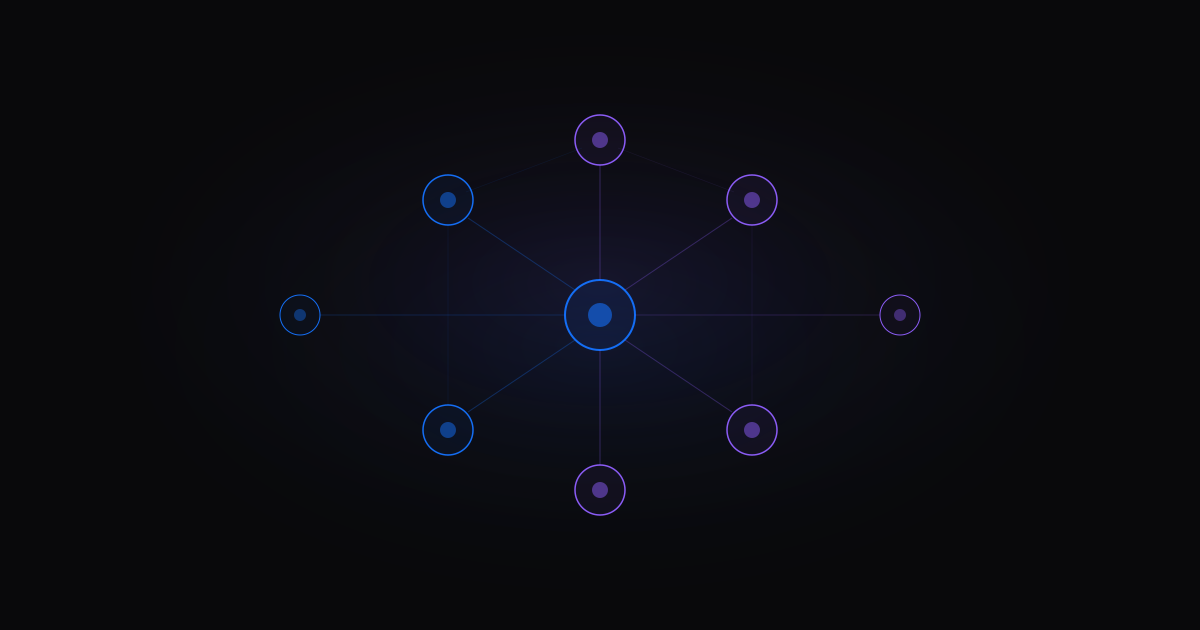
A hub agent acts as a router. It receives incoming requests, classifies them by type, and dispatches each request to the appropriate specialist agent. Specialists do not communicate with each other. They receive a task, complete it, and return results to the hub.
This pattern optimizes for throughput. The hub can be lightweight and fast, doing nothing but classification and routing. The specialists can be heavy and slow, because they run in parallel.
Where it works best. High-throughput classification and routing, customer support automation, multi-tenant systems where different clients need different processing. Examples: an intake system that routes support tickets to specialized resolution agents, a document processing system that handles invoices, contracts, and correspondence with different agent pipelines.
Implementation details that matter. The hub’s classification accuracy is the entire system’s bottleneck. A misrouted request goes to an agent that cannot handle it, wastes compute, and returns garbage. We invest heavily in the routing layer, typically using a smaller, faster model specifically fine-tuned for classification rather than a general-purpose model.
Load balancing across specialists is the second critical concern. If 80% of requests go to one specialist, that agent needs horizontal scaling while the others sit idle. Autoscaling policies based on queue depth per specialist prevent both waste and bottlenecks.
Key Takeaway: No single architecture pattern is universally correct. The right choice depends on whether your workflow is predictable (hierarchical, pipeline), emergent (mesh), or high-throughput with diverse request types (star). Most production systems combine two or more patterns.
Making It Production-Grade
The architecture patterns above will get you a working demo. Production requires four additional capabilities that most teams underestimate.
Observability
Every agent decision must be logged, cost-tracked, and auditable. This is not optional. (For a deeper look at what happens when this is missing, see The AI Observability Gap.) In a system with 50 agents, a subtle error in one agent’s reasoning can cascade through the entire system. Without observability, you are debugging in the dark.
We instrument every agent call with: the input it received, the model it used, the tokens consumed, the latency, the output it produced, and any tool calls it made. This generates significant telemetry volume, typically 2-5KB per agent invocation. For a system processing 10,000 requests per day across 50 agents, that is 1-2.5GB of telemetry daily. The storage cost is trivial compared to the debugging time it saves.
Structured traces that connect a top-level request to every agent invocation it triggered are non-negotiable. When a customer reports a bad result, you need to reconstruct the exact path through your agent network in under five minutes, not five hours.
Fault Handling
Agents fail. Models hallucinate. APIs time out. Network connections drop. The question is not whether your agents will fail but what happens when they do.
Circuit breakers prevent cascading failures. If an agent fails three times in a row, the circuit opens and requests are routed to a fallback agent or a cached response. The circuit closes again after a cooldown period, and the system tests with a single request before resuming full traffic.
Fallback agents provide degraded but functional responses. If your primary analysis agent (running on a frontier model) is down, a fallback agent running on a smaller, faster model can provide a less detailed but still useful analysis. The user gets a result with a quality disclaimer rather than an error.
Retry policies must be thoughtful. Retrying a failed LLM call with the exact same input will often produce the exact same failure. Effective retries include perturbation: slightly rephrasing the prompt, adjusting temperature, or switching to an alternative model.
Cost Management
In a multi-agent system, costs can escalate quickly if every agent uses the most capable (and expensive) model available. Smart systems match model capability to task complexity.
Tiered model routing is the most impactful cost optimization. A classification task that achieves 98% accuracy with a small model does not need a frontier model. A simple data extraction that works reliably with a fast, inexpensive model should never be routed to a model that costs 30x more per token. In practice, we find that 60-70% of agent tasks in a typical system can run on smaller models without measurable quality loss.
Token budgets per agent prevent runaway costs. Each agent has a maximum token allocation per invocation. If it hits the limit, it must return its best partial result rather than consuming unbounded resources. This constraint also forces better prompt engineering, because teams cannot solve problems by throwing more context at the model.
Caching at the agent level is high-value. If the same query hits the same agent with the same input within a configurable window, return the cached result. For agents that process reference data or perform static lookups, cache hit rates above 80% are common.
Testing
Testing a multi-agent system is fundamentally different from testing a single-model application. You cannot just check whether the final output is correct. You need to verify that the interactions between agents are correct.
Contract testing validates that each agent produces outputs conforming to the schemas expected by downstream agents. This catches integration failures before they reach production. When Agent A’s output schema changes, contract tests immediately flag every agent that consumes Agent A’s output.
Integration testing runs full workflows with controlled inputs and verifies end-to-end behavior. These tests are expensive to run (they consume real model inference) but essential. We run a core integration suite on every deployment and a comprehensive suite nightly.
Chaos testing deliberately injects failures: killing agents mid-execution, introducing latency spikes, returning malformed data from one agent to test how downstream agents handle it. This is how you discover that your “fault-tolerant” system actually crashes when Agent 7 returns an empty response instead of an error.
Key Takeaway: Production multi-agent systems require four capabilities that demos never address: deep observability, graceful fault handling, per-agent cost management, and interaction-level testing. Skipping any one of these turns a promising prototype into an operational liability.
The Self-Improvement Loop
The most powerful property of a well-built multi-agent system is its ability to improve itself over time.
Every agent invocation generates performance data: latency, cost, output quality scores, downstream success rates. Aggregated over thousands of invocations, this data reveals patterns that no human operator would spot.
Pattern detection identifies recurring input types that consistently produce suboptimal results. If a particular class of customer query causes Agent 4 to retry three times before succeeding, that pattern is flagged for review. Maybe Agent 4 needs a better prompt for that query type. Maybe the task should be rerouted to a different agent entirely.
Strategy promotion takes successful patterns and encodes them as rules. If the system discovers that queries containing financial data produce better results when routed through a specialized financial analysis agent rather than the general-purpose analyst, that routing rule gets promoted from observation to policy. Over time, the system accumulates routing intelligence that no human could have designed upfront.
Automatic optimization adjusts operational parameters based on observed performance. If an agent consistently completes its work using only 40% of its token budget, the budget is reduced. If a cache consistently expires before it can serve a second request, the TTL is extended. These micro-optimizations compound. In systems we operate over 90-day periods, we typically see 15-25% cumulative cost reduction from automatic optimization alone.
The self-improvement loop turns your multi-agent system from a static tool into an evolving platform. The system you have after six months of production is materially better than the one you deployed on day one, without any manual intervention.
Where the Real Engineering Lives
Building a multi-agent demo is a weekend project. You can wire together a few API calls, add a simple orchestrator, and produce an impressive result for a controlled input.
Production is a different discipline entirely. It requires answering questions that demos never face. What happens when your orchestrator crashes mid-workflow? How do you roll back a partially completed multi-agent transaction? How do you maintain consistent behavior when you update one agent’s prompt while fifty other agents depend on its output format? How do you explain to a customer exactly why the system made the decision it made?
The barrier to building a multi-agent demo is low. The barrier to making it reliable, observable, and cost-effective in production is where the real engineering lives. That gap between demo and deployment is exactly where value is created, and it is where we spend our time.
Related Reading
- The AI Observability Gap covers the monitoring infrastructure multi-agent systems require.
- Why Your AI Gets More Expensive Over Time explains cost optimization patterns that apply to multi-agent architectures.
- Beyond Demos: Building AI Systems That Actually Work discusses the broader engineering discipline behind production AI.
Zylver ships AI products: Forge, Signal, Agents, Flows, and Meter. View all products.
More from Zylver
What your board needs to know about AI
Boards are being asked to provide oversight on AI at a moment when most board members lack the background to evaluate what they are hearing. The gap between what boards need to know and what they typically get in management presentations is real and consequential.
How AI is changing customer service
Customer service is one of the business functions most visibly transformed by AI. The changes are happening faster than most organizations planned for, and the outcomes depend heavily on implementation decisions that are easy to get wrong.
How to scale AI adoption from one team to the whole organization
Getting AI to work in one team is a different challenge from scaling it across an organization. What worked for the first team often fails when applied elsewhere, and the failure mode is usually invisible until the expansion is already stalled.
Get insights like this delivered monthly.
No spam. Unsubscribe anytime.