Why Your AI Gets More Expensive Over Time (And How to Reverse It)
AI costs often increase after deployment. Learn the engineering patterns for intelligent distillation, model routing, and cost optimization that reduce per-operation costs by 50-80%.
By Ramiro Enriquez
Three months after launching their AI-powered content pipeline, a SaaS company noticed something alarming: their monthly inference bill had tripled. Usage was up, but not by three times. The system was doing more work per request, prompts had grown longer as the team added edge-case handling, and nobody had revisited the model selection since launch day.
This is not a failure of AI. It is a failure of engineering. And it is happening at nearly every company that has deployed AI in production.
The dirty secret of most AI deployments is that costs scale linearly with usage by default. Every request hits an LLM. Every classification, every extraction, every summarization task fires off an API call to a model that charges per token. As usage grows, the bill grows at exactly the same rate. Sometimes faster, because teams tend to add more AI-powered features once the initial deployment succeeds.
The companies that have solved this problem treat AI cost optimization as an engineering discipline, not an afterthought. Their systems actually get cheaper per operation as they scale. That inverse cost curve is not theoretical. It is the result of specific architectural patterns that any team can implement.
The Three Reasons AI Costs Escalate
Before fixing the problem, it helps to understand why it happens so reliably.
1. Every call goes to an LLM, even when it should not
Most AI systems are built as straightforward pipelines: input comes in, gets sent to a language model, output comes back. This works perfectly in development and early production. The problem is that many of these calls are repetitive. A content moderation system reviewing social media posts will see the same categories of content thousands of times. A document classification pipeline processing invoices will encounter the same vendor formats repeatedly. An extraction system pulling data from standardized forms will produce identical outputs for structurally identical inputs.
In a typical production system, 40% to 80% of LLM calls are producing outputs that could be predicted without inference. But because there is no mechanism to detect this, every single one of those calls costs the same as the first time the system encountered that pattern.
2. No visibility into what is actually being spent
Ask most engineering teams what their AI costs are, and they can tell you the total monthly bill from their API provider. Ask them which operations are the most expensive, which calls are redundant, or which prompts are inefficient, and you will get silence.
Without granular cost tracking at the operation level, optimization is guesswork. Teams end up making broad, blunt changes: switching to a cheaper model across the board (which degrades quality), reducing the number of AI features (which reduces value), or simply accepting the cost as the price of doing business.
3. No mechanism to improve over time
Traditional software gets more efficient as teams optimize hot paths and refactor bottlenecks. Most AI systems do not have this property. They are static pipelines where the same prompt template processes every input the same way, regardless of whether the system has seen a thousand similar inputs before.
This is the fundamental architectural gap. AI systems are deployed with no feedback loop between operational data and system behavior. (For a full breakdown of where these costs originate, see AI Implementation Costs in 2026.)
Intelligent Distillation: The Methodology
The concept behind intelligent distillation is straightforward. The system observes its own operations over time, identifies calls that consistently produce the same outputs for similar inputs, and automatically converts those from expensive LLM inference to near-zero-cost deterministic functions.
Think of it as the system learning which of its own tasks are genuinely complex (and worth the cost of LLM inference) versus which have become routine (and can be handled by simple, fast code).
This is not caching. Caching stores exact input-output pairs and returns them on exact matches. Intelligent distillation identifies patterns across inputs, generalizes the rules that produce the outputs, and creates new functions that handle entire categories of inputs without any model inference at all.
The distinction matters because caching helps with duplicate inputs. Distillation helps with similar inputs, which is a much larger category in production systems.
A Concrete Example
Consider a content classification pipeline at a media company. The system processes incoming articles and assigns them to categories: politics, technology, sports, business, lifestyle, and so on. It handles 340 articles per day, each requiring an LLM call for classification.
At $0.015 per classification (a blended cost accounting for input and output tokens on a mid-tier model), that is $5.10 per day, or about $155 per month. Manageable. But this is one pipeline. A company running fifteen similar AI operations is looking at $2,300 per month, and that is before scaling up.
After two weeks of operation with pattern analysis enabled, the system has observed 4,760 classifications. The analysis reveals:
- 73% of articles can be classified by detecting specific keyword clusters, source metadata, and structural patterns that the system has extracted from its own successful classifications. Articles from certain RSS feeds, containing certain headline patterns, mentioning certain entities, are classified identically by the LLM every time.
- 19% follow partial patterns. The system can narrow the classification to two or three candidates with high confidence, then use a smaller, cheaper model to make the final call.
- 8% are genuinely ambiguous. These are the cross-domain pieces, the unusual topics, the content that legitimately requires the reasoning capability of a full LLM.
After distillation, the pipeline looks like this:
- 248 daily articles are classified by rule-based functions. Cost per classification: effectively zero (sub-millisecond compute, no API call). Latency drops from 800ms to 2ms.
- 65 daily articles route to a smaller, faster model at roughly one-fifth the cost per call. Cost: $0.003 per classification.
- 27 daily articles still go to the full LLM. Cost: $0.015 per classification.
The new daily cost: $0.00 + $0.20 + $0.41 = $0.61. Down from $5.10. That is an 88% reduction on this single pipeline, and the system continues to improve as it identifies more patterns in the remaining 27% of complex cases.
Multiply that across every AI operation in your stack, and the savings become material.
Three Engineering Patterns for Cost Reduction
Cost optimization is not a single technique. It is a combination of complementary patterns that compound over time.
Pattern 1: Detection and Auto-Distillation
This is the core mechanism described above. The system maintains a statistical model of its own operations, tracking input characteristics against outputs. When it detects that a class of inputs reliably produces the same output, it generates a deterministic function to handle that class.
The engineering requirements are specific:
-
Input fingerprinting. Every AI operation needs a way to characterize its inputs beyond simple hashing. This means extracting features that capture the semantically relevant dimensions of the input. For text classification, that might be keyword presence, length, source, and structural markers. For data extraction, it might be document format, field positions, and header patterns.
-
Output stability tracking. The system monitors whether the LLM produces consistent outputs for inputs with similar fingerprints. A pattern is only considered stable after a configurable confidence threshold is met, typically 95% consistency over at least 50 observations.
-
Automatic function generation. When a stable pattern is identified, the system generates a lightweight function (typically a decision tree or rule set) that replicates the LLM’s behavior for that input class. This function is validated against held-out examples before being promoted to production.
-
Continuous monitoring. Distilled functions are not permanent. The system continues to sample a percentage of “distilled” inputs, sending them to the LLM as a check. If the LLM’s output diverges from the distilled function’s output (suggesting the underlying patterns have shifted), the function is retired and the pattern re-learned.
Pattern 2: Token Compression and Prompt Optimization
Every token costs money. Most prompts are not optimized for token efficiency.
A typical system prompt might be 800 tokens of instructions, context, and formatting requirements. If that prompt is sent with every API call, and the system processes 10,000 calls per day, that is 8 million tokens per day spent just on the system prompt. At $3 per million input tokens, that is $24 per day, or $720 per month, on instructions alone.
Token compression attacks this from multiple angles:
-
Prompt distillation. Systematically reducing prompt length while maintaining output quality. This is not about removing useful instructions. It is about finding the minimal prompt that produces equivalent results. A well-optimized prompt is often 40-60% shorter than the original, with no measurable quality degradation.
-
Dynamic context loading. Instead of including every possible instruction in every call, the system includes only the instructions relevant to the specific input. A classification call for an obviously political article does not need the detailed instructions for handling edge cases in lifestyle content.
-
Response format optimization. Requesting structured outputs (JSON with specific schemas) instead of free-text responses reduces output tokens significantly. A classification that returns
{"category": "technology", "confidence": 0.94}costs a fraction of what a response like “Based on my analysis, this article primarily covers technology topics, with a high degree of confidence…” costs.
In practice, prompt optimization alone typically yields 20-35% cost reduction across a system.
Pattern 3: Tiered Model Routing
Not every task requires the most capable (and most expensive) model. A well-architected system routes each operation to the cheapest model that can handle it reliably.
The model landscape in 2026 spans a wide cost range. Frontier models charge $10-30 per million output tokens. Mid-tier models charge $1-5. Small, specialized models charge $0.10-0.50. And locally-hosted models, for organizations with the infrastructure, approach zero marginal cost.
Tiered routing works by classifying the complexity of each incoming operation before selecting a model:
-
Simple, well-defined tasks (formatting, basic extraction, template-based generation) route to the cheapest available model. These tasks do not benefit from advanced reasoning capabilities.
-
Moderate tasks (standard classification, summarization, translation) route to mid-tier models that offer good quality at reasonable cost.
-
Complex tasks (multi-step reasoning, nuanced analysis, novel situations) route to frontier models where the additional capability justifies the cost.
The classification itself can be extremely lightweight. A small model, or even a rule-based system, can assess task complexity in milliseconds at negligible cost. The key is that routing decisions are data-driven: the system tracks quality metrics for each model on each task type and adjusts routing thresholds based on actual performance, not assumptions.
Organizations implementing tiered routing typically see 50-70% cost reduction compared to routing everything to a single model.
The Observability Requirement
None of this works without robust observability. You cannot optimize what you cannot measure, and you cannot measure what you do not track.
Every AI operation in a production system needs to emit structured telemetry:
- Cost per operation. Not just the aggregate monthly bill, but the cost of each individual call, broken down by input tokens, output tokens, and model used.
- Latency per operation. End-to-end time from request to response, including queue time, inference time, and post-processing.
- Input characteristics. The features of each input that are relevant to pattern detection. This is the raw material for distillation.
- Output quality signals. Downstream indicators of whether the AI’s output was actually useful. Did the user accept the classification? Did the extracted data pass validation? Did the generated content get published without edits?
- Pattern metrics. How many operations are being distilled? What is the consistency rate of distilled functions? How much cost is being saved by each optimization?
This telemetry feeds dashboards that give engineering and business teams real-time visibility into AI economics. When the CFO asks why the AI bill went up this month, the answer should be specific: “We onboarded three new clients, which increased document processing volume by 40%. Our cost per document actually decreased by 12% due to improved distillation coverage.”
The investment in observability pays for itself quickly. Teams that can see their AI operations in detail consistently find optimization opportunities that more than cover the cost of instrumentation.
The Inverse Cost Curve
Here is the key insight that changes how you think about AI economics.
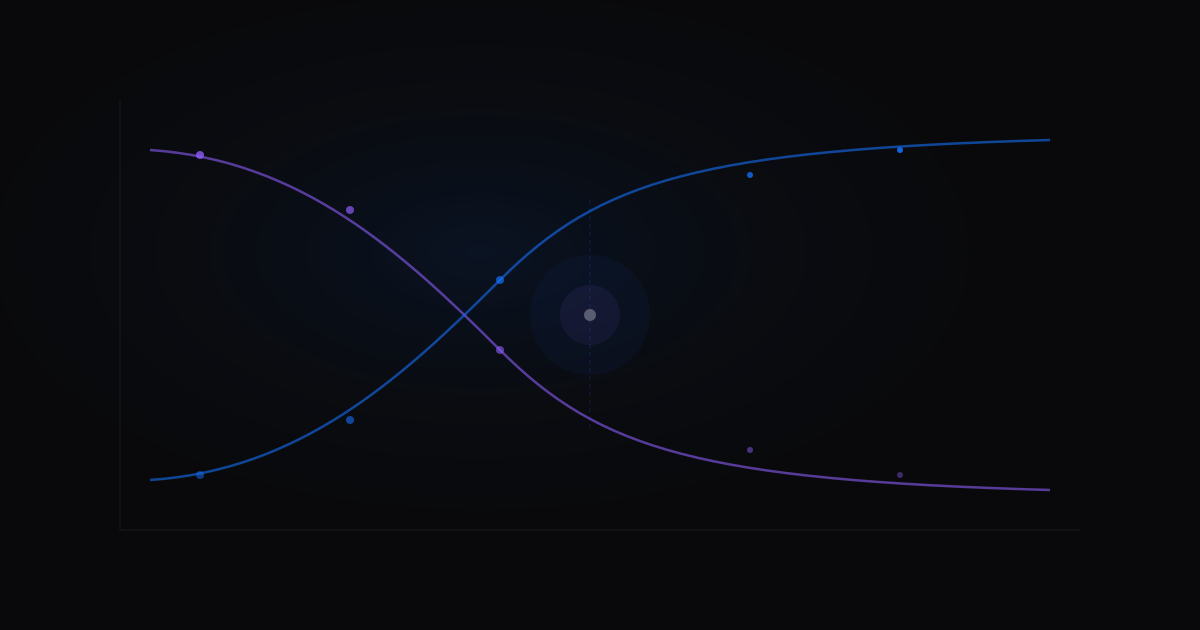
A well-engineered AI system has an inverse cost curve. The cost per operation decreases over time as the system processes more data. This is the opposite of what most companies experience, and the difference comes down entirely to architecture.
In the first month of operation, a properly instrumented system is collecting data and establishing baselines. Costs are at their highest because every operation runs through full LLM inference. This is the learning phase.
By month two, the first distillation patterns emerge. The most common, most predictable operations get converted to deterministic functions. Tiered routing begins adjusting based on observed model performance. Cost per operation starts to decline.
By month six, a mature system has typically distilled 50-70% of its operations. Prompt optimization has reduced token usage on the remaining LLM calls. Model routing has been refined through thousands of quality observations. The cost per operation may be 60-80% lower than it was at launch, while throughput and reliability have both improved.
This is not a theoretical outcome. It is the result of treating AI cost optimization as a first-class engineering concern from the beginning, building the instrumentation, the pattern detection, the distillation pipeline, and the routing logic into the system architecture rather than bolting them on after the CFO raises concerns.
This Is Engineering, Not Magic
The patterns described here are not exotic. Pattern detection, function generation, prompt optimization, model routing, operational telemetry: these are established software engineering practices applied to a new domain.
The gap in most organizations is not knowledge or capability. It is priority. AI systems are built with a focus on functionality, shipped to production with a focus on reliability, and only examined for cost efficiency when the bill becomes a problem. By that point, the architecture often makes optimization difficult without significant rework.
The alternative is to build with cost optimization in mind from day one. Instrument early. Track everything. Build the distillation pipeline alongside the inference pipeline. Implement tiered routing before you need it.
The companies that get this right do not just save money. They build AI systems that become more valuable over time: faster, cheaper, more reliable, and continuously improving. That is the engineering discipline that separates production AI from expensive prototypes.
Key Takeaway: A well-engineered AI system should get cheaper per operation over time. If your costs are flat or rising, the system lacks the optimization architecture to sustain itself economically.
Related Reading
- AI Implementation Costs in 2026 covers full lifecycle budgeting across all cost categories.
- The AI Observability Gap explains why you need observability before you can optimize costs.
- Multi-Agent Architecture Patterns discusses how model routing works in multi-agent systems.
Zylver ships AI products: Forge, Signal, Agents, Flows, and Meter. View all products.
More from Zylver
What your board needs to know about AI
Boards are being asked to provide oversight on AI at a moment when most board members lack the background to evaluate what they are hearing. The gap between what boards need to know and what they typically get in management presentations is real and consequential.
How AI is changing customer service
Customer service is one of the business functions most visibly transformed by AI. The changes are happening faster than most organizations planned for, and the outcomes depend heavily on implementation decisions that are easy to get wrong.
How to scale AI adoption from one team to the whole organization
Getting AI to work in one team is a different challenge from scaling it across an organization. What worked for the first team often fails when applied elsewhere, and the failure mode is usually invisible until the expansion is already stalled.
Get insights like this delivered monthly.
No spam. Unsubscribe anytime.